Sergeyich's relocation of his apiary to Vesele
Grey BeesSergeyich’s relocation of his apiary to Vesele is a wartime departure shaped less by a desire for safety than by responsibility for the bees. He leaves Little Starhorodivka with six hives, determined to move them beyond the fighting so they can continue their natural work. The journey separates him from Pashka and the home that had protected him, then brings him into a new community where his strength proves insufficient and help must be accepted from strangers.
The decision to leave
The move begins after Sergeyich receives a brief reply from Petro: the same word Sergeyich had texted him, “Alive?”, but without the question mark. Relieved, Sergeyich gathers his belongings. The contrast between an ordinary trip and this departure shapes his preparations. In peacetime he could pack for a sanatorium in ten minutes; now he has no such destination in view, and he loads his roomy green Lada with the possibility that a shell might hit his house while he is gone.
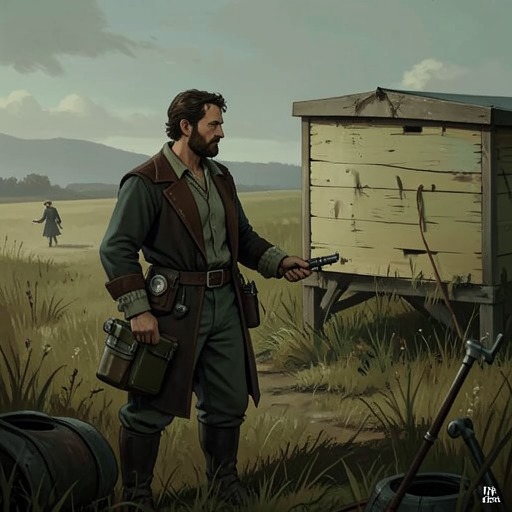
He packs clothes alongside two books from the sideboard: Nikolai Ostrovsky, with dollars tucked inside, and War and Peace, with hryvnias. Then he fills three canisters with petrol and prepares the trailer and hives for travel. The entrances must be closed so the bees do not scatter on the road; the hives must be loaded one by one, covered with a tarpaulin against the rain, and strapped down. He also packs jars of honey, reasoning that honey holds its value like money.
The weather helps make the journey possible. At around ten degrees, the cool rain can keep the hives from overheating on a bumpy road; warm weather would have required him to travel at night, because agitated bees raise the temperature inside their hives. The move is not simply the transport of property. It is a practical problem of keeping living colonies safe in wartime conditions.
A farewell to home and Pashka
Before leaving, Sergeyich stops at Pashka’s house to hand over the key to his front door. Pashka presses him to stay for tea and a stronger drink, then accompanies him toward the road in his red jacket with the white cross. The proposed farewell at the end of Pashka’s street does not hold: Pashka keeps going farther down the road because he cannot bring himself to say goodbye. As the Lada pulls away, his jacket dwindles in the rear-view mirror, and he returns alone.
Sergeyich leaves Karuselino in the rain, uncertain whether its yards are living or dead. Most seem empty, though freshly washed linen flutters in one yard. The image catches the departure’s unresolved character: the village is neither simply abandoned nor wholly alive. Behind Sergeyich, the war has made a queue of cars and people waiting to pass. After he drives beyond the last car, the road ahead and the rear-view mirror are both empty. He switches on the high beams and feels a brief, almost youthful exhilaration at the apparent openness of the road, even as he recognizes that the feeling is unjustified.
He understands that he has been a resident of a war in which he did not take part, and that he would not have left Pashka alone if the bees had not needed to go. People can move between peace and war; bees cannot understand the distinction. They must be allowed to collect and spread pollen. The destination therefore answers a biological need as much as a human one: Sergeyich is seeking quiet and the coming bloom of herbs and fruit trees for the colonies in his care.
The journey’s limits
At the forest, Sergeyich finds a cared-for picnic area with a rough wooden table, benches, a rubbish pit and a large fire pit. He drives farther and parks beneath an oak, then puts his ear to a hive and whispers for the bees to hold on. When he removes the straps and tarpaulin and tries to lift a hive, the effort stops him. His hands have lost their strength; his collarbone and shoulders hurt. He lowers the hive gently rather than dropping it. The body that has carried him through years of beekeeping cannot complete the move alone.
He asks a group of men drinking beer for help moving the hives, offering honey as payment. They refuse. The proposed exchange cannot overcome their unwillingness, and Sergeyich must keep looking for assistance. The scene makes the honey’s double role plain: it is a store of value he can offer, but it cannot guarantee cooperation.
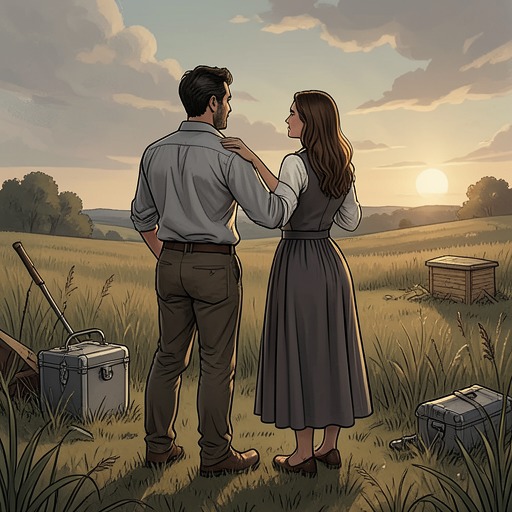
Galya does help. Together they move the six hives and arrange them in two staggered rows, three nearer the forest and three in front of the gaps, with roughly two metres between them so the bees have a similar view in every direction. Sergeyich is astonished by Galya’s strength: the first hive feels almost weightless because she has taken most of its weight, along with that of its inhabitants. The successful transfer depends on a person he has only just met, and on a physical effort he could not manage by himself.
A new livelihood in Vesele
After unloading the hives, Sergeyich brings Galya two one-litre jars of honey, three kilograms in all, and offers more for her to sell. Galya suggests paying him in groceries so he can feed himself. The arrangement begins as practical mutual assistance: honey meets a need for food, and her help has already made the relocation possible. It also establishes a human connection at the place where the bees are to settle.
As summer advances, the sound of the bee wings becomes a measure of life for Sergeyich as well as of the colonies’ health. He sees himself not merely as the owner of an apiary but as the representative of the bees’ interests. Their central needs are nectar and pollen; their internal life, including relations between worker bees and drones, is theirs to conduct. He watches the queens’ health, drives out wasps, uncaps honeycomb, and gathers honey, wax and pollen. The bees do not ask for his advice or permission; his responsibility is to protect the conditions in which they can live and work.
Galya’s claim that the honey is anti-alcoholic helps it sell in neighbouring villages. The money accumulates in the glove compartment of Sergeyich’s Lada, which serves as a lockable wallet. Galya later pays for the honey supply in advance, but the exchange does not become merely commercial. She rides her scooter to the campsite if she has not seen him for more than three days, while Sergeyich visits the village two or three times a week to fill his water canister, eat at her home and buy tea, sausage and cheese. His relocation thus develops into a workable routine, sustained by both the bees’ productive labor and ordinary acts of human care.
Significance of the relocation
The move shifts Sergeyich out of the war’s immediate landscape without making him independent of it or secure from hardship. Its governing image is not a heroic escape but a careful transfer: entrances closed, hives strapped down, a journey paced for the bees, and each colony placed where it can orient itself. The bees’ need to continue gathering pollen gives Sergeyich a reason to leave even when leaving means abandoning Pashka to loneliness.
The relocation also revises the relation between human strength and dependence. Sergeyich can plan the journey, protect the colonies from heat and road shocks, and understand their needs, yet he cannot lift the hives alone. The refusal of the men at the forest and Galya’s unexpected assistance mark two different responses to his request. In Vesele, honey first serves as a proposed payment and then as the beginning of an exchange that joins his livelihood to Galya’s help. The apiary reaches a new setting, but its survival depends on a wider network of care: bees, weather, flowers, a beekeeper’s labor, and the people willing to help him begin again.